In the Microsoft Dynamics 365 ecosystem, there is a distinct line between knowing of Business Central and truly knowing how to architect a business. For the Functional Consultant, true fluency isn’t just about configuration it’s about understanding how value flows across an organization.
After over a decade in this space, from Navision’s Classic Client to the cloud-native BC world, I’ve seen projects succeed on the strength of core integration. While specialized extensions and niche verticals are exciting, a consultant’s authority is forged in five foundational modules.
If you are a consultant building your roadmap toward becoming a Microsoft Certified Trainer (MCT) or aim for an MVP nomination, mastering these modules is not optional.
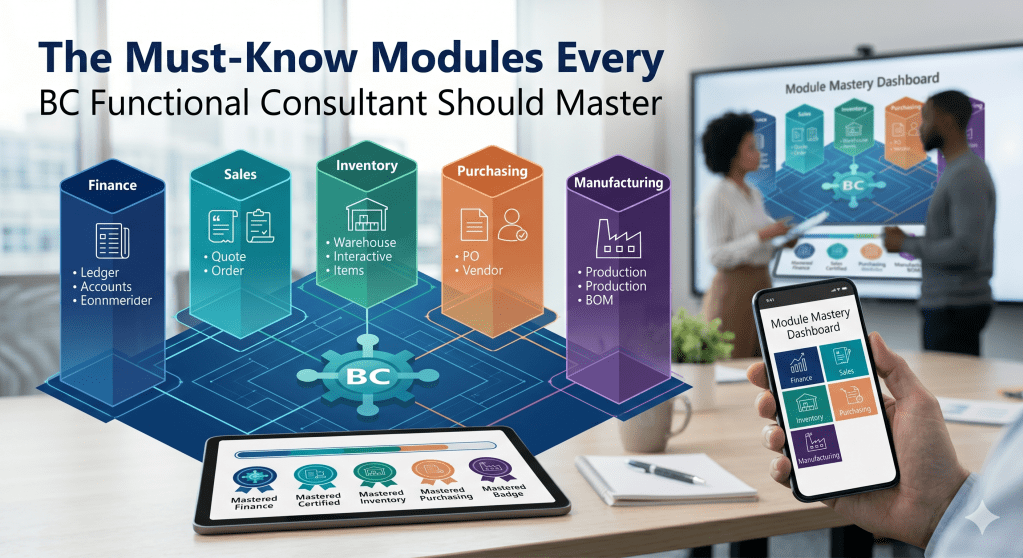
1. Finance: The Foundational Ledger (G/L)
Everything in Business Central leads to the General Ledger. If you cannot explain G/L Entries vs. Detailed Ledger Entries, or how the Posting Setup impacts financial statements, you must start here. Mastery of Finance isn’t just about journals; it’s about understanding Dimension management, VAT/Tax flow, Cash Management, and the Fixed Assets lifecycle.
- Consultant Checklist: Chart of Accounts structure, Dimensional Analysis, Posting Groups, Intercompany Setup.
2. Sales and Receivables: Orchestrating the Customer Journey
This module is the heartbeat of a business’s revenue. You must master the flow from Lead-to-Order and how standard pricing interacts with campaign/special pricing. Understanding how to handle partial shipments, warehouse reservations, and invoice corrections (Credit Memos) is crucial for keeping a customer satisfied and the aging report clean.
- Consultant Checklist: Sales Quotes to Orders, Blanket Orders, Standard Pricing vs. Special Price lists, Customer Templates.
3. Inventory: The Core Physical System
Inventory is where technical complexity often meets operational reality. A consultant must master Item Card structure (Stockkeeping Units vs. Variant codes), Valuation methods (LIFO/FIFO/Average), and Tracking (Lot vs. Serial numbers). You are the gatekeeper of item accuracy, ensuring the Item Ledger always matches physical reality.
- Consultant Checklist: Item Tracking Codes, Item Attributes, Lot Size, Reordering Policies, Inventory Posting Setup.
4. Purchasing and Payables: The Vendor Lifecycle
The counterpoint to Sales, Purchasing requires careful management of the supply chain. You need to master Purchase Quotes to Invoice flow, Vendor management, and how to configure intricate Purchase Price/Discount agreements. Crucially, pay close attention to the Receiving and Invoicing setup this is a critical audit point.
- Consultant Checklist: Purchase Order Workflow, Blanket Orders, Standard Vendor Purchase Codes, Drop Shipment flow.
5. Manufacturing (Light): The Integration Point
While deep Discrete or Process Manufacturing is a specialization, a Functional Consultant must understand ‘Light’ Manufacturing. Why? Because Assembly Management bundling items on the fly or assembling-to-order is a powerful feature for many distributors. You must understand Bills of Materials (BOMs), Production BOMs, and how to calculate a simple roll-up cost.
- Consultant Checklist: Production/Assembly BOMs, Assembly-to-Order (ATO) vs. Assembly-to-Stock (ATS), Standard Cost Roll-up.
The Architecture of Mastery
Mastering these five areas transforms a consultant into a true Solution Architect. Why? Because you can now see the Dependencies. You know that a Sales Invoice cannot post correctly if the Inventory Reordering Policy is wrong, or if a Finance Dimension isn’t linked properly on the Posting Group.
This deep integration knowledge is also the essential framework for the future I discuss on this blog: Agentic ERP. To build an AI agent capable of autonomous inventory management or customer collections, that agent must first understand the structural rules of these five core modules.
What is your strongest functional area, and which module are you focused on mastering next? Let’s discuss in the comments!


Leave a Reply