
Choosing the wrong inventory costing method during a Microsoft Dynamics 365 Business Central implementation is one of the hardest mistakes to correct later. Costing methods directly dictate how your inventory valuation is recorded on the balance sheet, how Cost of Goods Sold (COGS) is calculated on the income statement, and how variance is handled in manufacturing.
In Business Central, you can choose between five costing methods: FIFO, LIFO, Specific, Average, and Standard. However, the vast majority of enterprise implementations revolve around three core choices: FIFO, Average, and Standard.
In this guide, we’ll break down the mechanics, accounting impacts, and best-fit business scenarios for each of these three primary costing methods.
1. First-In, First-Out (FIFO)
How It Works
Under FIFO, Business Central assumes that the oldest inventory items purchased or produced are the first ones sold or consumed. The system tracks item inventory value based on actual purchase cost layers (Item Ledger Entries and Value Entries).
When a sales shipment is posted, BC applies the cost of the oldest available inventory batch to COGS.
Purchased Batch #1: 10 units @ $10/ea (Jan 1)
Purchased Batch #2: 10 units @ $15/ea (Jan 15)
Sale of 12 units on Jan 20:
├── 10 units @ $10 = $100
└── 2 units @ $15 = $30
Total COGS = $130 | Remaining Inventory = 8 units @ $15 ($120)
Best Fit For:
- Retail, Distribution, & FMCG: Companies where physical stock naturally moves on a FIFO basis to prevent expiration or obsolescence.
- Fluctuating Purchase Prices: Businesses operating in inflationary environments where tracking actual batch costs reflects true market margin.
Architect Note: In Business Central, FIFO valuation is dynamically updated when you run the Adjust Cost – Item Entries batch job. Always run cost adjustment before generating financial reports!
2. Average Costing
How It Works
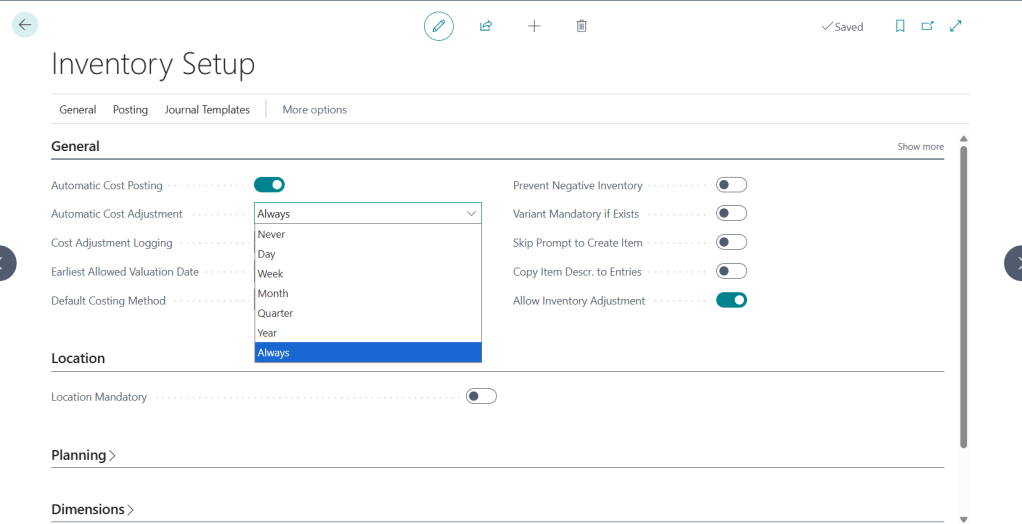
Under Average costing, Business Central calculates a weighted average unit cost for an item based on purchases within a defined time period (defined on the Inventory Setup card, usually daily or monthly).
Average Unit Cost = Total Inventory Value (LCY) / Total Inventory Quantity
When an item is sold, COGS is posted using the current calculated weighted average unit cost at that exact point in time.
Beginning Stock: 10 units @ $10 = $100
New Purchase: 10 units @ $20 = $200
Total Pool: 20 units = $300 ──> Average Cost = $15/unit
Sale of 12 units:
└── 12 units @ $15 = $180 COGS | Remaining Inventory = 8 units @ $15 ($120)
Best Fit For:
- Commodities & Bulk Goods: Items stored together in bins or silos where individual batch tracking is impossible (e.g., liquids, grains, gravel, fuel).
- High-Volume, Low-Value Items: Fast-moving catalog parts where price fluctuations are small and batch tracking adds unnecessary administrative overhead.
3. Standard Costing
How It Works
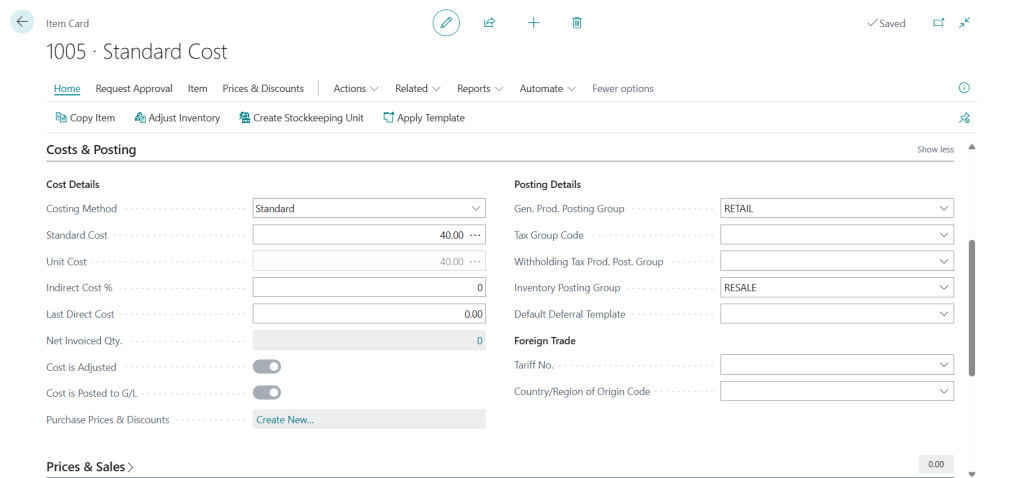
Under Standard costing, inventory is valued at a fixed, predetermined target cost set on the Item Card. Regardless of what you actually pay a vendor or spend on production labor, inventory is always received into stock at the Standard Cost.
Any difference between the actual purchase price (or production cost) and the predefined Standard Cost is immediately posted as a Variance to the Income Statement at the time of invoicing or production order closure.
Standard Unit Cost set on Item Card: $12.00
Actual Purchase Order Price: $15.00/unit (for 10 units)
Receipt to Stock: 10 units @ $12 = $120 (Inventory Balance Sheet)
Vendor Payable: 10 units @ $15 = $150 (Accounts Payable)
Purchase Variance: -$30 posted directly to G/L Purchase Variance Account
Best Fit For:
- Discrete Manufacturing: Companies with complex Bills of Materials (BOMs) and Routings where costs need to be stabilized for quote estimation and performance analysis.
- Repetitive Production: Environments where management evaluates efficiency by comparing actual performance against predefined budget standards.
Direct Comparison Matrix
| Feature / Metric | FIFO | Average | Standard |
| Valuation Principle | Actual historical cost layers | Weighted average across period | Predefined budget target |
| Impact on COGS | Mirrors exact purchasing cost sequence | Smooths out price volatility | Fixed at standard rate |
| Handling Volatility | High price fluctuations show in margins | Blends fluctuations over time | Creates Purchase/Material Variances |
| Ideal Modules | Sales, Purchasing, Distribution | Bulk Wholesale, Distribution | Manufacturing, Assembly |
| G/L Complexity | Moderate (Requires Cost Adjustment) | Moderate (Requires Revaluation) | High (Requires Variance Account Setup) |
Common Pitfalls & Troubleshooting
| Issue / Error | Root Cause | Solution |
| Gross Margin looks wrong on Sales Reports | Costing method is FIFO/Average, but Adjust Cost – Item Entries hasn’t run. | Set up Automatic Cost Adjustment in Inventory Setup or run the batch job via Job Queue daily. |
| Huge Purchase Variances in G/L | Standard Cost set on the Item Card is outdated or inaccurate compared to actual supplier rates. | Perform periodic Standard Cost Rollups using the Standard Cost Worksheet before the start of a fiscal year. |
| Cannot change Costing Method | Item ledger entries already exist for the item. | Zero out inventory balance, close item entries, or block the old item and create a new Item Card with the correct method. |
Looking Ahead: The Agentic ERP Horizon 🤖
Selecting and maintaining costing methods requires constant vigilance to prevent financial reporting drift.
In an Agentic ERP architecture:
- An Autonomous AI Agent can continuously monitor cost variance thresholds across manufactured or purchased items. If a purchase price variance exceeds a defined limit (e.g., 5%), the agent notifies the cost accountant via Teams with a side-by-side analysis of raw material price trends.
- For FIFO/Average items, an AI agent can detect unadjusted item entries prior to financial period close, run the cost adjustment batch autonomously, and flag any inventory valuation anomalies before finance generates month-end statements.
Summary
Choosing between FIFO, Average, and Standard costing in Business Central comes down to business model alignment. Retailers and distributors thrive on FIFO, bulk commodity traders depend on Average, and discrete manufacturers rely on Standard. Getting this foundational decision right during discovery ensures accurate margins, clean audits, and reliable business reporting.
 Agentic ERP Blog